

City News
The Mayor's Office
Mayor Danny Avula: Remarks as Delivered at Richmond SailFest
Good morning, friends!
This is a super exciting day in our city. It is a joy to welcome people from far and wide. I know throughout the course of this weekend, we will have many visitors from the region and from beyond. We also have these crews from Norfolk, from Baltimore, and all the way from the Netherlands. Let's welcome our guests and thank them for coming here for these celebrations.
The James River, in so many ways, is the lifeblood of our city today, but it has been for hundreds and hundreds of years. It has played an incredibly important role in the history of our Commonwealth and the history of our entire country. This whole year, as we acknowledge the 250th anniversary of our country, that means a lot of things here in Richmond. It is part celebration. It is part wrestling with the complexity of our past. It is part inspiration for how we continue to form a more perfect union for the next 250 years. I have lived here in this great city of Richmond for 26 years, and a huge part of what has fueled my love for this place is the way that Richmond does not shy away from its past. Our city is steeped in history. I think the greatness of our city, our beauty, our diversity, and the richness of Richmond are a direct result of the honest reckoning that we have done and been doing for decades here.
SailFest is yet another example of how we grapple with the fullness of that history and ultimately become a stronger city because of it. As we stand here on the banks of the James River, we celebrate the fact that we would not be here had it not been for the arrival of ships like these so many years ago. We also recognize that the history of ships sailing up the James River here to Richmond is really complicated.
When Captain Christopher Newport sailed here from Jamestown in 1607, he planted a cross on the hill, and with that began years of persecution of the land's original inhabitants, the Powhatan. Centuries before the Europeans arrived on these shores, remember that dugout canoes carried families and food and tools and traded goods between villages and tribes. We must remember that when these ships first sailed up the James more than 400 years ago, this land was not a wilderness waiting to be settled. It was already a vibrant network of relationships, of economic activity, and of community. Just like today, our river connected people. The Powhatan welcomed these new European settlers in their most vulnerable moment and taught them how to survive in this new environment. Ultimately, as greed gave way to war and violence, within a generation, most of the tribes between the York and the James River were decimated. Too many of the land’s first inhabitants in the place that we now call Richmond were lost to history.
In the years to follow, the James River would carry thousands of enslaved Africans into the city. Right across the river here, thousands of kidnapped men, women, and children arrived at Ancarrow’s landing, and walked along the riverbank, eventually making their way to Shockoe Bottom, where they were confined, tortured, and sold into a life of slavery. In the 19th century, Richmond became one of the largest slave hubs in the United States. So many enslaved Africans came through Richmond, that even today, it is believed that one in four Black Americans can trace their roots back to our city.
Throughout all of this time, the river and the ships that traveled along it were also a source of commercial development for Richmond, and of freedom. George Washington oversaw the building of the Kanawha Canal along the James River, which was the first operating canal system in the US. That canal connected Richmond and other Eastern cities to the Western United States, and it expanded travel and commerce from our city and for the nation as a whole. In the years to follow, Black and Irish laborers would endure dangerous conditions to expand that canal and grow our city's economy by helping transport flour and tobacco and coal and people, both free and enslaved, up the treacherous falls of the James and ultimately around the world.
If you look at our City's flag, you will see a faceless boatman, a boatman that represents the unsung heroes -- the boatman of the James -- that transported goods along the river, and were such an important part of our city's early economy. It's believed that, at one point, up to 98% of these boatmen were men of color, and that the river was actually a source of freedom for these men and their families, both figuratively and literally. Not only did the river provide an avenue for enslaved boatmen to travel without the harsh supervision of their masters, but they were also known to help transport slaves to freedom by picking up freedom seekers along their journey, and taking them to ships here in Richmond that would ultimately carry them north. I think these Black boatmen were the epitome of our country's founding ideals of liberty and justice for all. With great bravery and wisdom, they turned the same river that brought their ancestors into a life of slavery into a pathway to freedom. I'm so proud that they are represented at the center of Richmond's flag, which is a representation of their legacy, but also of our aspiration to live up to it as a city.
Now, while the tall ships that we see today aren't the same vessels that ushered in the difficult parts of Richmond's conflicted past, they do allow us to reflect on that past, and to celebrate the progress that we've made, but also to acknowledge the work that we have yet to do. We have been working to live up to that promise of freedom and equality for 250 years, but we are still working on it. The work to create a truly democratic nation rooted in equality remains unfinished.
I welcome you all again to SailFest, because this is an incredible once in a generation opportunity to tour these beautiful ships, to learn from live performances and reenactments and exhibits that will allow us to engage with and reflect on our complex history over the last 250 years. This event has come together with the work of many, many hands. I just want to say thank you to Sail Virginia, to the crews of these fantastic ships, the Oosterschelde, the Pride of Baltimore, and the Virginia.
I want to say a special thank you to Jamie and your team at the Virginia Museum of History and Culture. We are so grateful for the work that you all do for our city and for the entire state, telling the fullness of Virginia's story. I want to offer a massive thank you to the United States Army. It took so much coordination and effort to get these floating docks out here so that these ships could dock. I want to thank the Army certainly for their involvement in this event, but more importantly to your sacrifice and service to our great nation. Lastly, I want to thank my colleagues here in the city of Richmond, who, along with Sail Virginia and the History Museum, put in so many hours of planning and physical labor, and set up the infrastructure that's needed to bring the tall ships here and to make this event a success.
I cannot wait for thousands and thousands of Richmonders to get to experience this over the next few days, and then to see how that work will seed the future of Richmond, to make us a stronger and more resilient and more beautiful city over the next 250 years. Thanks so much, everybody.
Importance of Implementation Planning: Mayor Danny Avula (Newsletter)
|
|
City of Richmond Acts to Safeguard Community Trust, Clarify Role of RPD
New initiatives include further restrictions on Flock data sharing
Richmond, VA — Today Mayor Danny Avula announced a set of actions the City of Richmond is taking to safeguard community trust and draw a clear line between local policing and federal immigration enforcement. These actions, recommended by the Mayor’s Inclusive Communities Preparedness Work Group, formalize and expand upon the administration’s longstanding position that the Richmond Police Department does not enforce federal immigration law and does not coordinate with U.S. Immigration and Customs Enforcement (ICE).
“The fear our neighbors are feeling right now is real — the fear of going to work, taking children to school, or even running everyday errands like going to the grocery store,” said Mayor Danny Avula . “Our city government exists to serve all Richmonders, and we will continue to work to build the trust that is essential to keeping our communities safe.”
The actions include:
Increased Flock data sharing restrictions. In addition to cutting off all federal agency access to its license-plate reader data, the Richmond Police Department will now prohibit sharing Flock Safety data with any jurisdiction in Virginia that has entered into a 287(g) agreement with ICE. This helps ensure that technology deployed to solve local crimes in Richmond is not used as a tool for immigration enforcement in other localities across the Commonwealth.
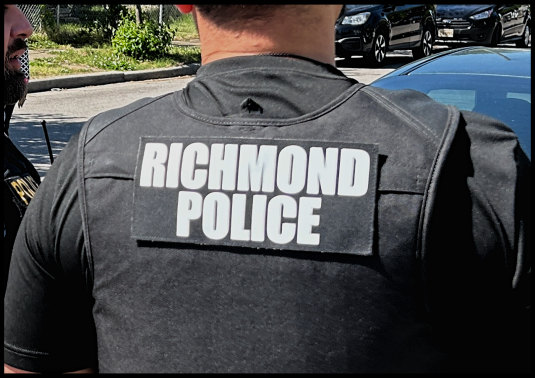
RPD uniform updates. The Richmond Police Department will update officer uniforms to read “RICHMOND POLICE”, making them clearly and visually distinguishable from federal law enforcement agents. Reports from across the region have described ICE agents conducting enforcement operations in dark tactical gear that closely resembles local police, creating confusion and fear in communities. The uniform changes will help residents immediately identify RPD officers from their local police department.
Prohibiting ICE from staging operations on City property. The City will prohibit federal agencies from using City-owned property — including buildings, parking lots, and public facilities — to stage immigration operations, process detainees, or conduct surveillance related to immigration enforcement.
Raising concerns directly to ICE. The administration will establish a regular cadence of meetings with ICE’s Richmond field office to raise concerns from residents, communicate the City’s policies and expectations, and ensure open channels of communication. This proactive approach allows the City to advocate directly for the safety and dignity of Richmond residents while still upholding its commitments to resident safety.
“The Richmond Police Department’s mission is community policing — building trust, strengthening relationships, solving crimes, and keeping neighborhoods safe,” said Chief Rick Edwards . “We understand that some residents may feel uncertainty or concern when they see law enforcement activity in their neighborhoods. That is why it is important that the public can clearly identify our officers and know who we are when we respond to serve the community. We want every resident to feel safe calling us for help, reporting crime, or speaking with an officer. Our focus is, and always will be, protecting the people of Richmond and working in partnership with the communities we serve.”
Richmond has not entered into a 287(g) agreement with ICE and does not participate in the enforcement of federal immigration law. In January 2026, Mayor Avula established the Inclusive Communities Preparedness Work Group to identify additional steps the City can take to respond to emergent threats and challenges facing immigrant communities.
The Richmond Police Department’s Hispanic Liaison can be reached at 804-646-5158 or [email protected] .
La Ciudad de Richmond actúa para conservar la confianza de la comunidad y aclarar el papel de su Departamento de Policía
Las nuevas iniciativas incluyen mayores restricciones en el intercambio de datos de las cámaras Flock
Richmond, Virginia — El alcalde Danny Avula anunció hoy un conjunto de medidas que la Ciudad de Richmond está tomando para conservar la confianza de la comunidad y trazar una división clara entre las autoridades policiales locales y las agencias federales de inmigración. Estas acciones, que fueron recomendadas por el Equipo de Trabajo de Preparación de Comunidades Incluyentes del alcalde, formalizan y expanden la posición establecida por la administración desde hace tiempo de que el Departamento de Policía de Richmond (RPD) no lleva a cabo ningún tipo de acción relacionada con las leyes federales de inmigración, ni tampoco se coordina con la Autoridad de Aduanas e Inmigración (ICE) de los Estados Unidos.
Dijo el alcalde Danny Avula : “El miedo que ahora tienen nuestros vecinos es real: el miedo de salir a trabajar, de llevar a sus hijos a la escuela, inclusive de realizar actividades diarias y rutinarias como ir a la tienda a hacer mercado”, y añadió: “El gobierno de nuestra ciudad está aquí para servirle a todos los richmondeses y seguiremos trabajando para establecer la confianza que es indispensable para mantener seguras a nuestras comunidades”.
Las medidas incluyen:
Un aumento en las restricciones de intercambio de datos de Flock. Además de cortar por completo el acceso de las agencias federales a sus datos de los lectores de placas, el Departamento de Policía de Richmond ahora prohibirá compartir los datos del sistema de seguridad Flock con cualquier jurisdicción de Virginia que haya entrado a un acuerdo 287(g) con ICE. Esto ayuda a asegurar que la tecnología que desplegamos para resolver delitos locales en Richmond no sea utilizada como una herramienta de vigilancia de inmigración en otras localidades de la Mancomunidad.
Actualizar los uniformes del RPD. El Departamento de Policía de Richmond cambiará sus uniformes de manera que ahora tengan escrito “RICHMOND POLICE” (“Policía de Richmond”), para hacerlos visualmente diferentes de los utilizados por los agentes de las autoridades federales de inmigración. Existen informes de toda la región que han descrito el vestuario de los agentes de ICE que realizan redadas como “equipo táctico de colores oscuros”, muy parecidos a los de la policía local, lo que crea confusión y temor en las comunidades. Estos cambios en el uniforme ayudarán a la población a identificar inmediatamente a los agentes de policía de Richmond.
Prohibir que ICE se reúna para preparar sus operaciones en instalaciones municipales. La Ciudad prohibirá que las agencias federales utilicen propiedades municipales, incluyendo edificios, estacionamientos e instalaciones públicas, para montar sus operaciones de inmigración, procesar a los detenidos o ejercer actividades de vigilancia relacionadas con las redadas de inmigración.
Presentar sus inquietudes directamente a ICE. La administración establecerá una secuencia regular de reuniones con la oficina de campo de ICE en Richmond, con el fin de plantear las inquietudes de los richmondeses, comunicar las políticas y expectativas de la Ciudad y asegurar que existan canales abiertos de comunicación. Este enfoque proactivo permite que la administración municipal abogue directamente por la seguridad y dignidad de los habitantes de Richmond, al tiempo que mantiene su compromiso con la seguridad de la población.
Dijo el jefe de policía Rick Edwards : “La misión del Departamento de Policía de Richmond es proteger a la comunidad, estableciendo confianza, fortaleciendo relaciones, resolviendo delitos y manteniendo las comunidades seguras”, y agregó: “Comprendemos que algunos richmondeses sientan incertidumbre o preocupación cuando ven actividades policiales en sus vecindarios; es por eso que es importante que el público pueda identificar claramente a nuestros agentes y oficiales y sepa quiénes somos cuando respondemos y le servimos a la comunidad. Queremos que cada persona se sienta segura cuando nos llame pidiendo ayuda, informando sobre un delito o al hablar con un agente. Nuestra meta es, y siempre será, proteger a la población de Richmond y trabajar en colaboración con las comunidades a las que servimos”.
Richmond firmado ningún acuerdo 287(g) con ICE, ni participa en la ejecución de las leyes federales de inmigración. En enero de 2026, el alcalde Avula creó el Equipo de Trabajo de Preparación de Comunidades Incluyentes para identificar otras medidas que puede tomar la Ciudad para responder a las nuevas amenazas y desafíos a los que se enfrentan las comunidades inmigrantes.
También pueden comunicarse con la oficina de Enlace Hispano del Departamento de Policía de Richmond llamando al 804-646-5158 o escribiendo al correo [email protected] .
Mayor Danny Avula's Statement Regarding Veto of Senate Bill 378 and HB 1263
Public sector collective bargaining has been working in Richmond since 2022, when we became one of the first localities in the Commonwealth to establish bargaining units across our workforce.
Collective bargaining has enabled us to strengthen services for residents by working in partnership with our most valued resource, our people. It’s an essential tool, and we are proud of the progress we have made for our workforce and for the communities we serve.
Our partners in labor, in the General Assembly, and in Governor Spanberger’s Administration are committed to the same principles of giving workers a seat at the table and using collective bargaining to strengthen public services. We know that work will continue and we’re eager to lend our experience to it.
Meanwhile, in Richmond, our collective bargaining agreements remain in place and our relationships with our bargaining units and workforce leadership are strong.
I remain committed to collective bargaining as a tool that strengthens public services and supports our workforce.
Mayor Danny Avula on Richmond City Council’s Adoption of FY27 Budget
“The approved budget reflects not just shared investments, but a new way of working together — with earlier collaboration, clearer public engagement, and a real commitment to partnership between City Council, our administration, and the people of Richmond. Together, we made historic investments in affordable housing, funded Richmond Public Schools at record levels, supported our workforce, and focused our resources on building a thriving Richmond. I'm truly grateful to all who leaned in throughout this process. Now the real work begins: delivering on these investments thoughtfully, effectively, and with accountability to the people we serve.”
— Mayor Danny Avula
Highlights of the adopted FY27 budget:
Thriving City Hall
- Fully funding the City of Richmond’s contractual commitments to unionized City workers, with the largest of those investments being in public safety
- Sworn police and fire personnel will receive an average compensation increase of approximately 6.73%, which includes negotiated pay adjustments and step increases effective July 2026
- Union-represented employees across other collective bargaining units will receive a 3.25% salary increase, consistent with their agreements, effective July 2026
- Fully funding a 3.25% increase for all employees across the organization starting on July 1; this was made possible by a joint Administration-Council reprioritization of previous allocation to GAP grants
- Increased contracted security workers’ pay rate to $20/hour minimum and moved contracted janitorial workers to $18/hour minimum without disrupting their staffing model
Thriving Neighborhoods
- More than $40 million for affordable housing, anti-displacement strategies, and neighborhood safety improvements
- $11.7 million for the redesigned Affordable Housing Trust Fund
- $1.8 million in Affordable Housing Performance Grants
- $1,100,000 investment in Family Crisis Funds for residents experiencing acute crises, including but not limited to housing instability, utility disconnection, food insecurity, and other urgent needs
- $1 million for eviction diversion programs to help tenants stay in their homes, and
- $7.4 million in tax relief for older adults and residents with disabilities
- Council amendment ($300,000) to more fully utilize Southside Community Center and better engage youth and older adults
Thriving Families
- $257 million proposed for Richmond Public Schools, an $8.2 million increase over FY26 and the largest allocation for RPS ever
- $9.3 million investment school infrastructure improvements and facility upgrades
- $500,000 to facilitate students’ and families’ access to critical services, benefits, and programs by supporting Communities in Schools site coordinators in RPS schools
- $500,000 to reduce costs of childcare and support childcare providers through tuition assistance funded by the Early Child Care & Education Trust Fund
- $1 million for after-school programming at all seven RPS zone middle schools through the Middle School Alliance
- $850,000 to Positive Youth Development to provide access to community-based out-of-school time opportunities for youth 11-19 and help prevent youth violence; and
- $625,000 to fund the Children and Families grantmaking process for local nonprofits that support the education, health, and development of children and families
- $483,000 in order to provide transportation and security for RPS students to participate in After School programs; Council amended
Thriving Economies
- $4.9 million for Economic Performance Grants to support major economic development projects that create jobs, activate underused spaces, and drive long-term economic growth
- $250,000 for commercial façade improvements to help small businesses invest in storefront upgrades that strengthen neighborhood commercial corridors and attract customers; and
- $125,000 in funding to support a Business Improvement District (BID) in Carytown, strengthening business vitality through cleaner sidewalks, safer streets, and coordinated support for local businesses.
The FY27 budget takes effect July 1, 2026.
Or search using "Type it, find it" above
Pinned
Most Recent
Or search using "Type it, find it" above